
Lifelong Learning Master's Degree in Architecture Industrialisation: Design and Processes


Home
- Type of programme
- Màsters
- Campus
- Campus Barcelona
- Duration
- October-June
- Schedule
- Monday–Thursday (15.30–20.00)
- Language
- Spanish
- Modality
- On site
Why to study this masters
- Lead industrialised construction
Learn to approach a project holistically, from design and construction systems through to manufacturing, off-site production, logistics, assembly, quality assurance and life cycle management.
- Integrate the technologies transforming the sector
Integrate the technologies transforming the sector. Go beyond theory and gain hands-on experience with BIM, parametric design, automation, robotics and digital fabrication, applying these technologies to real architecture and construction projects and processes.
- Connect with industry
Take part in workshops, placements and projects developed in collaboration with companies and professionals from the sector, and gain first-hand insight into factories, production centres, laboratories and building sites linked to industrialised construction.
- Specialist teaching staff
Learn from a multidisciplinary teaching team of professionals and experts specialising in industrialised construction, sustainability, advanced manufacturing, digitalisation and innovation.
- Boost your professional profile
Develop a cross-disciplinary profile for careers in prefabrication industries, architectural practices, engineering consultancies, construction companies, property development firms and technology companies, specialising in areas such as BIM, off-site production, sustainability, automation, digital fabrication and innovation.
- Compulsory professional placements in sector companies
Undertake placements in companies and institutions linked to architecture and industrialised construction, applying your knowledge to real projects and professional challenges.
Industrialised architecture is driving a new way of building: more efficient, digitalised and sustainable, creating new professional opportunities. Discover the figures that reflect this transformation.
- Modular construction is projected to reach a global market value of US$207.8 billion by 2033.
- The transition to more sustainable construction could create 6.5 million additional jobs worldwide by 2030.
- A reduction of up to 15% in waste generation is associated with off-site construction, according to the European Commission.
Other similar studies
Presentation
Goals
- Master the principles and systems of industrialised architecture and construction.
- Integrate architectural design, technology and production processes in industrialised projects.
- Apply advanced digital tools, automation and new technologies to design and construction.
- Understand and select industrialised materials, components and building systems.
- Manage the entire life cycle of an industrialised project: design, manufacturing, logistics, assembly, maintenance and end of life.
- Incorporate sustainability criteria and life cycle assessment into decision-making.
- Understand and manage off-site production processes.
- Explore new management, business and collaboration models linked to the industrialisation of the sector.
- Develop a critical, innovative perspective focused on the technological transformation of architecture and construction.
- Work in interdisciplinary teams and collaborative professional environments that connect architecture, engineering, industry and construction.
- Develop applied research skills and the ability to adapt to emerging technologies in response to current and future sector challenges.
Who it is aimed at
The master’s degree is aimed at graduates in Architecture, Architectural Technology, Industrial Engineering, Civil Engineering and Civil Works Engineering who wish to deepen their knowledge of industrialisation and emerging construction technologies. It is also intended for professionals wishing to develop their careers further and specialise in this field.
Competences. Output profile
Graduates of the programme will be able to:
Knowledge:
- CN01 Understand the theoretical, technical and regulatory foundations of industrialised architecture and their application within the construction sector.
- CN02 Identify the main industrialised construction systems, off-site manufacturing processes and digital technologies applied to architectural design and production.
- CN03 Understand the principles of sustainability and the circular economy.
Competencies:
- CP01 Promote innovation and technological transformation processes in the field of industrialised architecture and construction.
- CP02 Critically evaluate industrialised construction solutions, taking into account their technical, economic, social and environmental impact.
- CP03 Communicate and defend technical and strategic proposals.
Skills:
- HB01 Apply advanced digital tools, BIM methodologies and parametric design in the development of industrialised projects.
- HB02 Integrate technical, logistical, environmental and economic criteria in the selection and coordination of industrialised construction systems.
- HB03 Develop industrialised architectural projects through collaborative work in multidisciplinary environments.
Career opportunities
Key career paths for graduates include:
- Specialist in the design and development of industrialised construction components
- BIM project and digital process coordinator for industrialisation initiatives
- Specialist in off-site manufacturing, logistics and construction management
- Consultant in sustainability, life cycle assessment and circular economy applications for industrialised buildings
- Innovation and digital transformation manager within construction companies
- Specialist in automation, digital fabrication and emerging technologies for architecture
- Manager of collaborative processes across architecture, industry and construction
The master’s degree also provides a strong foundation for academic and research careers related to technological innovation, new construction systems, process digitalisation and sustainability in architecture and construction.
The qualification also provides a pathway to applied research projects undertaken in collaboration with national and international organisations and institutions.
Facilities
The facilities at the UIC Barcelona School of Architecture are designed to offer you a high-quality educational experience. With innovative spaces and advanced technology, you will develop your skills in real and practical environments. From the model workshop and digital fabrication labs to spacious work classrooms, every corner of our school is designed to provide you with the best resources for your learning and professional development.
-
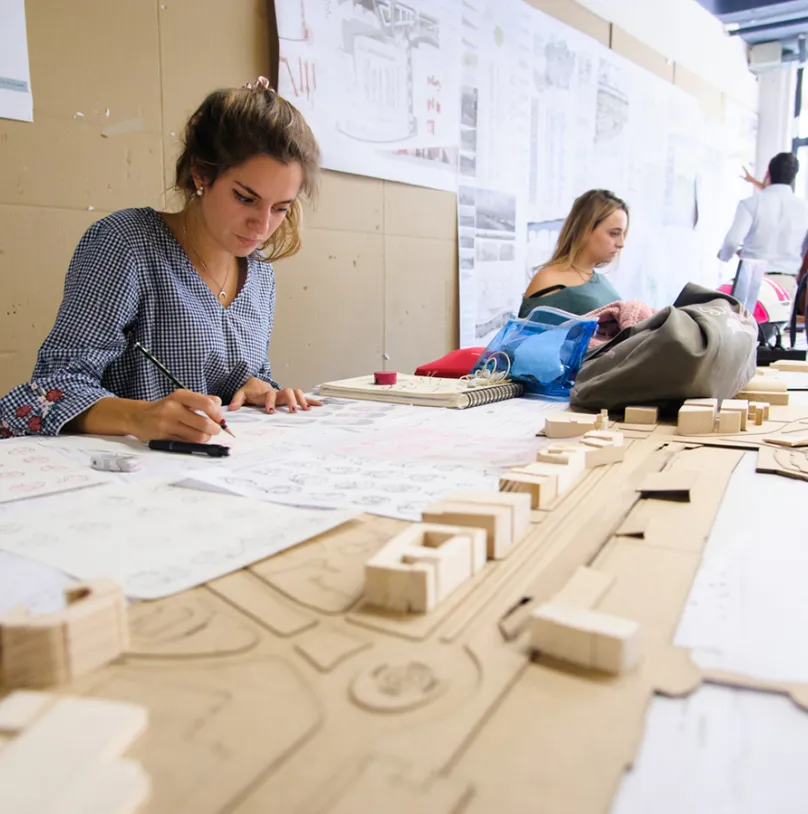 24/7 access to workshop classrooms
Our workshop classrooms and plotter room are available 24/7, allowing you to work flexibly on your projects and transport your projects at your convenience. Design, experiment, and create whenever suits you best.
-
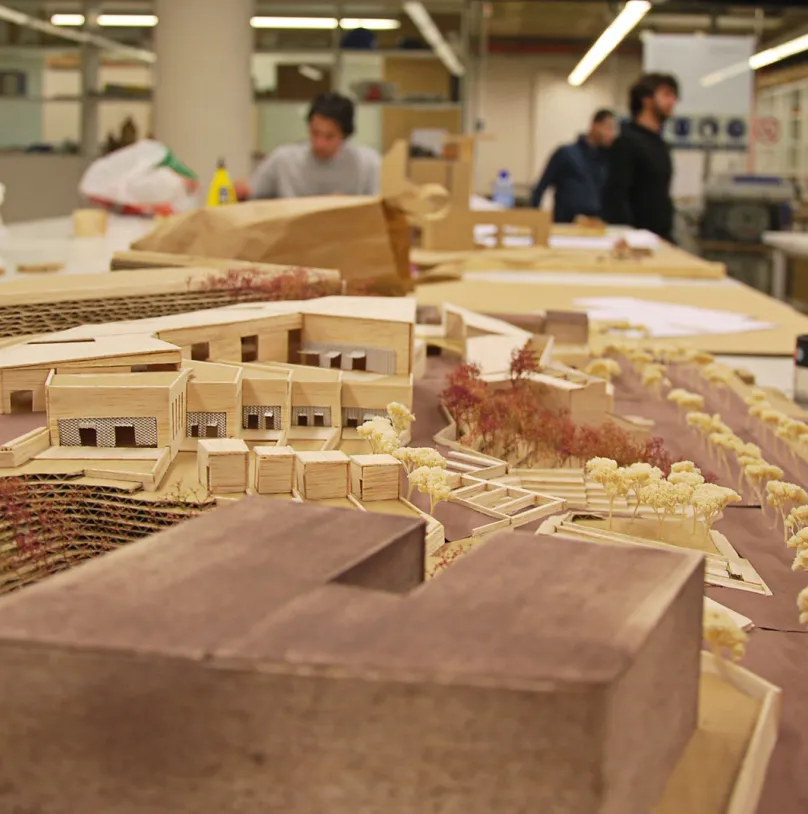 Model workshop
A fully equipped space for building physical models with precision tools, ideal for turning your ideas into tangible formats.
-
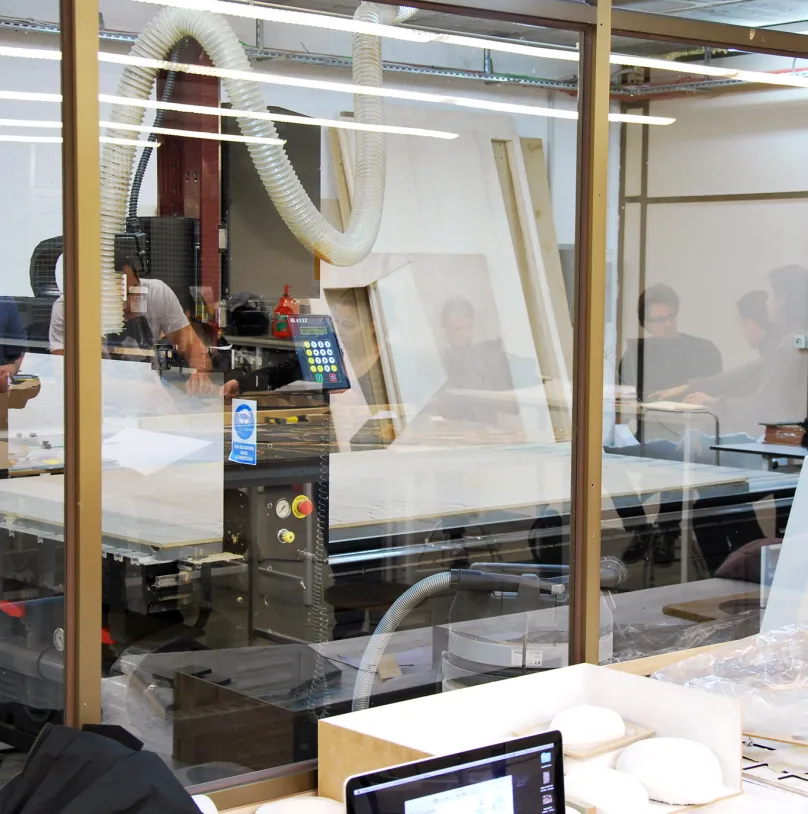 Digital architecture workshop
State-of-the-art technology to bring your projects to life: 3D printing, laser cutting, and CNC milling, enabling experimentation with innovative materials and forms.
Information sessions
Attend the next Informative Session
The University is organising open days for future university students who would like to know more about our institution and the programmes we offer.
Admission process
Admission process for master's and postgraduate programmes
-
Request information
-
Application for admission
- Delivery of documentation
- Validation of documentation
Assessment of candidate
Result of admission process
- Admission
- On hold
- No admission
Deposit paid
Enrolment
Between July and September
- Tuition paid
Welcome!
You are now part of UIC Barcelona
To enrol on the Master’s Degree in Architecture Industrialisation, applicants must hold an official Spanish university qualification or an equivalent qualification issued by a higher education institution within the European Higher Education Area (EHEA) that grants access to master’s-level studies in the country of issue.
Applicants holding qualifications from education systems outside the EHEA may also be admitted without formal recognition of their degree, provided that the University verifies that their qualification represents an equivalent level of education and grants access to postgraduate studies in the country where it was awarded.
The admissions process will give particular consideration to the suitability of the applicant’s academic and professional profile in relation to the programme’s educational objectives. Student selection will be based on the following assessment criteria and weightings:
| Weighting | Criteria | Aspects assessed |
|---|---|---|
| 40% | Academic record | Average grade obtained in the university degree |
| 30% | Currículum vitae | Professional experience related to architecture, engineering, construction, industrialisation, digitalisation or sustainability |
| 20% | Letter of motivation | Motivation and alignment of the applicant’s profile and interests with the programme |
| 10% | Specific knowledge | Knowledge of digital tools, BIM technologies, or experience in construction processes and technical management |
Admision process
If you have decided to study this master’s degree programme, follow the steps below to complete your application. We recommend submitting your application as soon as possible, as places are limited.
1. Online application for admission
2. Send the following documentation (*)
Applicants with an official Spanish university qualification
- Certified copy of the university degree certificate, or certified copy of the receipt confirming payment of the degree issuance fees.
- Certified copy of the academic transcript for completed university studies.
Applicants with an official foreign university qualification
- Original legalised copy of the university degree certificate.
- Original legalised copy of the academic transcript for completed university studies.
For all applicants:
- One passport-sized photo.
- One photocopy of your national identity card (DNI) or passport.
- An up-to-date CV.
- A letter of motivation
- If the original documentation is not in Spanish, an original sworn translation into Spanish of the university degree certificate and academic transcript must also be submitted.
3. Interview
The Master’s Degree Admissions Committee may conduct personal interviews with candidates when considered necessary to assess the suitability of their profile, motivation and previous experience.
Admision criteria
In accordance with Article 16 of Royal Decree 861/2010, applicants must hold an official Spanish university degree, bachelor's, diploma, engineer or architect or an equivalent qualification issued by a higher education institution within another member state of the European Higher Education Area that grants access to master’s-level studies in that country.
The admission tests consist of a weighted assessment of the candidate’s professional and research record.
Once a decision regarding your admission has been made, the Information and Admissions Service, responsible for managing the tests, will communicate the result to each candidate.
Reserving a place and enrolment
Candidates who have been accepted into a master's or postgraduate degree programme will receive an acceptance letter that is contingent on payment of the reservation fee.
- A place reservation is made effective by payment of the amount specified for the respective programme, within ten business days of receipt of the admission acceptance letter.
- Once the place reservation has been completed, should a student fail to meet the admission requirements established by national or regional legislation in force at the relevant time, not possess the required qualification, or should the programme fail to open due to insufficient enrolments, UIC will refund the full reservation fee.
- If a student voluntarily withdraws from the programme for any reason, UIC will retain the full reservation fee as compensation for any resulting loss or damage and no refund will be made.
- Non-payment of the reservation fee will be understood as a decision to decline the offer of admission. In such cases, UIC may cancel the application and withdraw the offer of a place.
Prices, grants and financial aid
Grants
UIC Barcelona offers various fellowships supported by both public institutes (MEC or AGUAR), as well as private UIC Barcelona funds.
For further information, please check with our admissions department:
Grants offered by UIC Barcelona for master's degrees and postgraduate programmes
Discounts
- 10% discount for former students of UIC.
- 15% discount for current UIC students in their final year at the time of applying for admission.
- 10% discount for special and general large families and special single-parent families.
- 50% discount for students with a recognised disability of 33% or above
Other grants
Those pursuing master's degrees or postgraduate programmes studies at UIC Barcelona are also eligible for other scholarships.
Financing
In order to make tuition fee payments easier for students, UIC Barcelona offers various financing options through its partner banks.
Payment conditions
- 40% discount if payment is made within 10 days of formalising enrolment. Any reservation fee already paid will be deducted. (20% of the tuition fee within 15 days of admission.)
- 20 % by 30 November
- 20 % by 31 January
- 20 % by 31 March
Payment facilities
UIC Barcelona offers different payment options.
Alumni Ambassador
The Alumni Ambassadors are volunteer alumni who will explain their experience at UIC Barcelona to you. With them you will be able to resolve any doubts that may arise about the chosen program, the University and your experience as a student.
What questions can you ask an Alumni Ambassador?
- What do you value most about this program?
- What profile of students studied it?
- What do you think about teachers?
- What professional practices did you do?
- What are the advantages of studying in Barcelona?
- If he/she already has a job and if he had a hard time finding one.
Don't miss this magnificent opportunity to learn first-hand what it means to do a program at UIC Barcelona and the value it brings you in the development of your career. If you have any specific questions about the admission process, scholarships, visas or financial aid, you can contact directly admisiones@uic.es.